

Looking Forward to a Social Media Platform Better Than Facebook


Image result for Free images of horse and buggies
Image result for Free images of Ford Model T

    Everyone has heard of the Ford Motor Company, but virtually nobody remembers that the Cleveland Hardware and Forging Company was once a major producer of wagons and carriages.  As the Ford Motor Company made technologically superior means of transportation than the once popular horse-drawn alternatives, Ford overtook and surpassed its technologically inferior competitors.  The social media platform Orkut is the Cleveland Hardware and Forging Company of the social media industry.  Orkut was a major industry leader and collapsed to its technolocially superior competitor, Facebook, in 2014.

      Orkut was a market leader for seven years, reaching its peak in 2012 with 30 million users.  Orkut was a subsidiary of Google, and many were attracted to the platform by Google’s reputation.  Alas, Google has floundered on the social media front.  Google+ failed in early 2019.  A few of the things Orkut did right, but were not valued by subsequent social media apps, is the focus on account privacy, an invitation-only culture that led to prestige in being an Orkut user, and the ability to rate other users in intangible areas like how sexy, cool, and trustworthy they were.  Orkut succeeded in Brazil for a variety of reasons.  Since Brazil bans outdoor advertising, Orkut became a way for Brazilians to find places and products.  Unfortuanely, Orkut did a poor job with video interfacing causing users to look to other places for product recommendations and social expression.

     Pachal Debbarma attributes Orkut’s failure to not being able to provide the same level of features as Facebook, which was Orkut’s nearest rival. Orkut used an older, more clunky and slow architecture.  Orkut was more privacy-minded not allowing users to anonymously view other user’s content.  Orkut was not as visually appealing nor as interactive as rival Facebook.  Orkut did not provide online gaming as part of its platform, as did Facebook.  And, Orkut was not business-friendly, not allowing businesses to have their own business-oriented pages. 

     The proverb, “If you want to be successful, build a better mouse trap,” is true in the transportation industry and in the social media realm.  Overall, Facebook provided a more relevant platform than Orkut.  Users voted by changing platforms.  Facebook certainly has annoying features, like the targeted advertising.  Purchase a baby stroller on Amazon and one is subjected to weeks of baby stroller ads on Facebook.  Facebook hasn’t quite figured out that once the item is purchased the horse is out of the barn.  No need to advertise for a major purchase couples typically do only once.  I don’t like them spying on my online activities for the purpose of ad targeting.  I don’t like Facebook’s posting algorithm.  I don’t like the same post popping up every two minutes in my feed.  I can’t wait for another social media platform to overtake Facebook making it obsolete.  It’s a platform I begrudgingly use, but I love to hate.  Let’s go tech industry.  The world needs a better social media app.  Facebook, like Orkut, is just a horse and buggy.

References

Cleveland Hardware. (2019) Encyclopedia of Cleveland History. Retrieved from https://case.edu/ech/articles/c/cleveland-hardware

Debbarma, Pachal. (2016, August 9) “Case study : Reasons why Google’s Orkut failed after Facebook was launched. Also know what Orkut’s founder is doing recently to start up  again.” http://www.medium.com. Retrieved from https://medium.com/@PachaelPhillip/case-study-reasons-why-googles-orkut-failed-after-facebook-was-launched-92dd8a7abf0

Mahoney, L. Meghan and Tang Tang. (2017) Strategic Social Media: From Marketing to Social Change. Chichester, West Sussex, UK.ess
Weixin is a Gift to the Surveillance State

Image result for Free gifs and photos "police state"

     Weixin is a gift to the survelliance state.  I’m taking a graduate level “Social Media Marketing” course as part of my MFA program in Creative Writing.  In addition to learning about American social media, we’re also learning how social media is done in other countries and cultures.  In China, a social media app called Weixin has more than a billion downloads and is the predominant app for “everything” in China.  It’s pronounced “way-shin.”  I couldn’t pronounce it either.  From its inception by parent company, Tencent, in 2011, Weixin has become the predominant app in China used to find things, chat, purchase products, conduct financial transactions, share photos, and make videos.  This is remarkably convenient if one is a law-abiding, Communist-loving, apolitical, Chinese citizen.  But, one’s account can be shut down if one criticizes the Communist party or shares images or statements critical of the government.  With a person’s entire “life” on this app, including banking accounts, the Communist party can destroy a person with a mouse click.  Go-along to get-along or else.  This app is a survelliance state’s easist way to crack down on dissidents.

     As an American, with First Amendment rights to free speech (even stupid speech), it’s easy to be critical of the billions of Chinese people who have downloaded and use the Weixin app.  Unlike Americans, they don’t get to choose their governmental leadership.  China has been ruled by despots and dictators for centuries.  But, even in a democratic republic, like the United States, the elected government still struggles with surveillance.  The National Security Agency (NSA) has been eavesdropping on the telecommunications industry for decades.  Even with safeguards in place, whistleblowers like Edward Snowden (https://www.bbc.com/news/world-us-canada-23123964) show that illegal data collection on Americans continues despite the official policies that prohibit such activity.  The technology to do so has tempted “the government” to cross the line in order to make the nation a “safer” place.  The argument goes that law-abiding citizens have nothing to fear by surveillance.  Only criminals would object to this snooping.  And, while there is a logic to this argument, that logic no longer applies when the government becomes corrupt, or small parts of government.  When a surveillance state has control over a person’s life, with tools like the Weixin app, a single mouse-click can spell economic and social disaster for a person who gets on the wrong side of government, or that corrupt little piece of it.  Citizens trade their anonymity and due process over to governmental agencies that enforce cryptic “user terms of agreement.”  Go-along to get-along becomes the passive citizen’s mantra for enjoying the app’s benefits.

     And, Weixin DOES provide benefit.  One of the cute little features that caught my eye was the Red Envelope campaign where a user can gift money to friends and relatives using a random distribution set by the app.  For instance, a user can donate a total of $50 to be split among four people.  One recipient might get lucky and get $30, while another might get just $2.  This totally is fun and would spark the gambler instincts in participants.  The downside is that financial information must be shared with the app.  Weixin has taxi-finding features, a Chinese eBay function, restaurant ordering features, text and photo sharing, and many others.  It’s designed to be a one-size fits all social media platform.  EVERYBODY has it says BBC journalist Stephen McDonell (https://www.bbc.com/news/blogs-china-blog-48552907). McDonell intentionally posted images of the 30 year anniversary of the Tiananmen Square Uprising and got his account banned. Read the user agreement carefully.  Go-along to get-along.

     Nearly every dystopian novel or movie begins with some new technology that simplifies life for users and connects them with others.  Then, the surveillance state uses that technology to exploit the users, enslaving them in a system where not-getting-along means imprisonment, death, or persecution.  Millions of Russian and Chinese citizens have been abused by their dictatorships in the twentieth century for criticizing the government.  New monitoring capabilities makes it even easier for modern surveillance states to abuse its citizens.  In an existing surveillance state, like China, the dystopia is already out of the bag.  Short of a mass uprising, that surveillance genie isn’t going back into the bottle.  But, it’s not too late for democracies and republics to simply decline the tempting features offered by social media giants.  I won’t take any satisfaction in saying “I told you so,” after you’ve sold your soul to the mega-corporations who control social media.  Now is the time to insist on regulation, transparency, ability to decline surveillance-capable features, and user agreements that can be negotiated.

To Pink or Not to Pink

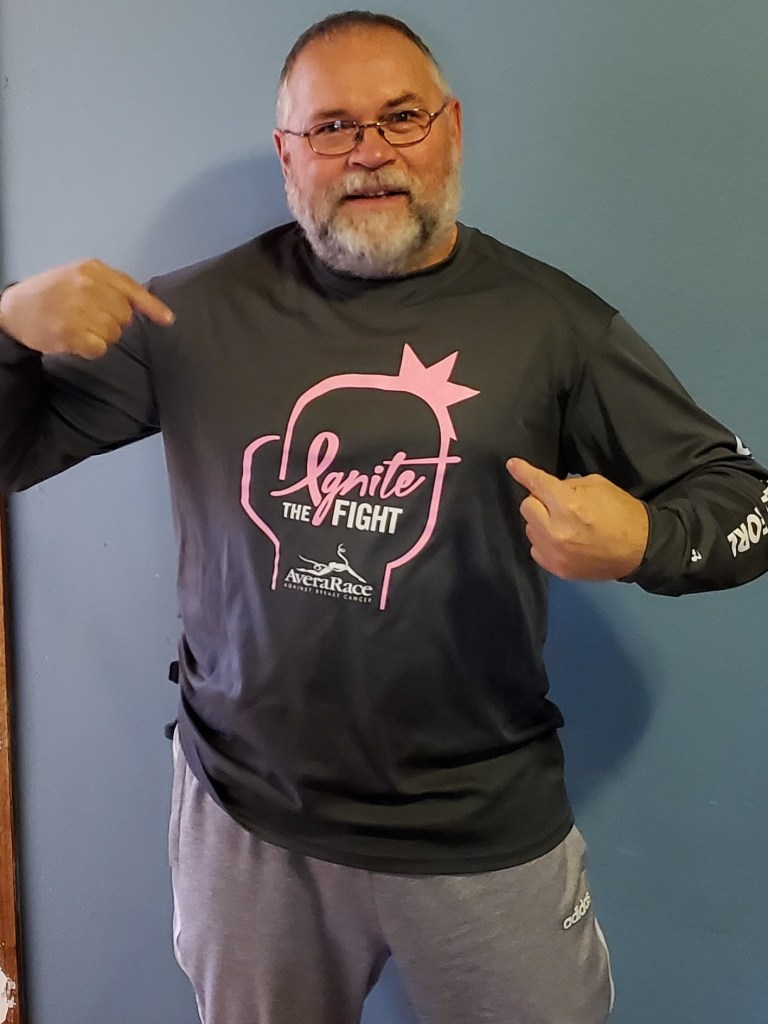
      Breast Cancer Awareness month was last month and I’m coming to the party a little late.  Here I am wearing one of my new favorite shirts which is a “thanks for playing” gift to those who ran a 5K last month promoting breast cancer awareness.  No, I didn’t run in the race, but the shirt is comfortable.  Plus, I’m intractably against breast cancer!  And, I’m not embarrassed to say that on social media. After all, breast cancer kills 42,000 people each year, and 400 of those deaths are men.  Nearly everyone knows somebody, or knows a family, who has been affected by breast cancer.  I have known people who both survived breast cancer and who have succumbed to its poison.  Who wouldn’t be against this terrible disease?

  Being against something in principle or doing something that makes a difference are two very different things.  While I’m against breast cancer in principle, I’ve not done much to combat the disease except wear a shirt with a pink logo. Every year it gets easier for men to wear pink. I’m from that generation of men who were raised to think pink was a color for girls.  Any man of my generation who wore pink was teased with comments like, “He sure is comfortable with his masculinity” or “He’s embracing his inner feminity.” It has taken decades for the color stereotypes to lessen.  (I actually looked at buying a hot pink dress shirt recently, seriously considering it before buying a safe blue dress shirt instead).  And, I think one of the reasons for this lessening is breast cancer awareness.

     The Susan G. Komen Breast Cancer Foundation (https://ww5.komen.org/) has excelled in its well-planned breast cancer awareness campaigns to increase charitable contributions, promote life-saving screening techniques and services, and de-stigmatize a devastating disease.  Meghan Mahoney and Tang Tang, in their popular textbook, Strategic Social Media: From Marketing to Social Change, report a popluar meme strategy during Breast Cancer Awareness month that went viral.  Women were sent private messages through Facebook asking them to list their name and the color of the bra they were wearing to their Facebook feed without explaining to the men in their lives what that post meant.  Other “fun” activities followed with the same format.  There are various explanations for why those particular memes went viral.  They were silly fun.  They didn’t require much effort.  Refusing to participate meant they might be accused of being against breast cancer awareness.  The conspiratorial nature of excluding men made the activity attractive.  Whether the viral meme did anything for breast cancer is still being debated.  There is no conclusive proof that contributions increased.  And, breast cancer awareness was not included in any of the public Facebook postings.

     Elamari Botha and Mignon Reyneke in their May 2013 article, “To Share or Not to Share: The role of content and emotion in viral marketing” published in the Journal of Public Affairs, concluded that people are more likely to share memes and videos on social media if they are familiar with the topic and have an emotional response to the content.  Breast cancer is familiar to most people and evokes powerful emotional responses making it an ideal subject for a social media campaign, especially when compared to less well-known diseases like the rare acute lymphoblastic leukemia.  That’s as good an explanation as I’ve read for why women made those memes go viral.

     Chipping away at stigma for breast cancer and instilling sympathy for breast cancer survivors has been a slow and arduous process.  I think social media techniques do no harm in the process of awareness.  I can’t tell you the exact moment I decided that wearing pink was no longer anti-masculine.  I suspect that breast cancer awareness campaigns through the years have been one of the factors.

Warby Parker for Glasses–Meh

      I’ve worn glasses since the 4th Grade when I admitted to my mom I could read a poster on the wall with my left eye but couldn’t read it with my right eye.  That poster was a newspaper headline of Custer’s Last Stand.  But, I digress.  Mom took me to an optometrist and I endured looking through a scope saying things like “One is clearer than Two.”  My first pair of glasses were brown plastic and remarkably fragile.  After six months or so the screws came out and a bit of black electrical tape was applied until I could get a new pair.  That was unpleasant, both being yelled at for breaking my “new” glasses and enduring the tape.  I’ve worn dozens of pairs of glasses since then.  And, mostly the process of buying new glasses is unpleasant.

     Warby Parker (https://www.warbyparker.com/) changed the industry-standard process for purchasing glasses in 2010 when they allowed people to order glasses online then try-on five pairs of glasses at home for free.  Currently, eyeglasses start at $95/pair at Warby Parker, which is cheaper than most optometrist shops but more expensive than Wal-Mart Optometry.  An eyeglass purchaser still must make the dreadful trek to an optometrist’s office to get a prescription, but now the purchaser has more options when selecting frames.  This is generally a good option for people who live in rural areas or who are too busy to deal with the lines at the optometry shops.  At Warby Parker, a client chooses five pairs online, tries them on at home, and returns the frames they don’t like at Warby Parker expense.  So far, the Warby Parker model is popular enough for them to be successful.

     The Warby Parker model isn’t really all that new.  Sears Catalog sales offered similar options for decades.  Customers would order from the Sears Catalog and return stuff they didn’t want.  And, most optometry shops, like Lenscrafters, still had to call in a customer’s order for delivery at a date in the future, sometimes by mail.  The difference between a retailer like Lenscrafters and Warby Parker is that with Warby Parker a customer could select their prospective frames online and never enter a brick and mortar store.

     I have a “fat” face so I have trouble finding glasses off the shelf at many of the brick and mortar stores, including Wal-Mart Optometry.  Warby Parker does have three different options for selecting face type when ordering online, but I’m skeptical they will be wide enough for me.  For exceptional people, there are advantages to going to a brick and mortar store to be properly fitted, rather than guess online.  Sure, one can return a frame at Warby Parker for free, but that process still takes time.  The small, medium, large sizes that have become predominant at the big box stores leaves so much of the population with ill-fitting clothing.  I fear that people who don’t fall into Warby Parker’s small, medium, large frame widths will end up with glasses that don’t really fit.  And, a “kinda fit” just makes one uncomfortable all the time.

     I’m glad Warby Parker is doing business online.  It keeps average people from adding to the lines at the brick and mortar stores. Am I tempted to change over to Warby Parker? Meh.